
Cafea Fortuna — The Journey of Coffee
Coffee is an evergreen shrub of the equatorial belt — cultivated in over 80 countries between the tropics of Cancer and Capricorn. Five of them lead the world.
Five landscapes shape the taste of every blend — from the Ethiopian highlands to the equatorial archipelago.
Of the many species in the genus Coffea — classified by Linnaeus in 1737 — only two matter in the cup. Two thirds of the world's production is Arabica.
Pleasant bitterness, distinctive acidity, and aromas ranging from chocolate to fruity-floral. Finer, and more expensive. Two thirds of the world's production.
Raw bitterness and an intense, full body — spicy, earthy, woody, chocolate aromas. Hardier, more productive, first grown in West Africa and Southwest Asia.
The bean we know is the seed of a fruit called a cherry — two beans placed face to face on the flat side, wrapped in a thin silverskin, a hard parchment, and a sweet gelatinous layer.
Everything that follows — harvest, processing, sorting — exists to free that seed without spoiling it.

By hand for Arabica — pickers choose only perfectly ripe cherries, because a single defective bean can spoil a cup. By shaking for Robusta, and traditionally in Brazil, where machines work vast, flat rows.
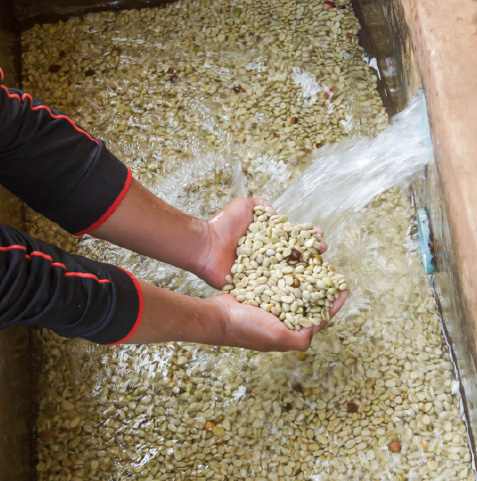
The wet method — for hand-picked cherries only. Water strips the pulp from the parchment-covered beans, giving a higher aromatic profile; the beans then dry in the sun for about 28 days, to 11% humidity.
The natural method — cherries dry whole in the sun for 3–4 weeks before mills remove the skin. Simpler, cheaper — traditional for Robusta, Brazil and Ethiopia.

Green beans are graded by size, shape, type, density, harvest time and taste; defective beans are removed mechanically and by hand. The parchment stays on wet-processed beans until just before export, protecting quality in the classic 60 kg bag.
Over 25 years of coffee processing. Tasting and selection of green coffee in the laboratory, storage, roasting, blending to recipe, grinding, packaging — an automated process supervised by specialists.
Every incoming batch is analysed physically and organoleptically — first and last impressions, flavour profile, acidity, body, balance. Coffee is tested on arrival, and again before it ever enters a blend.

"We chose to roast lightly — roasted more intensely, the fruity-floral aromas would disappear."
After roasting, coffees of different origins are combined in controlled quantities, following a standard recipe kept in the Fortuna laboratory. Every day, specialists cup dozens of coffees — from origin samples to the ready-roasted blend — so each assortment tastes the same, year in, year out.
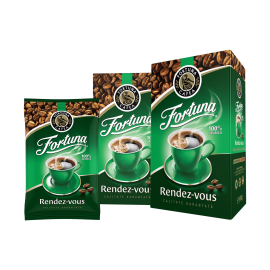
The perfect balance of sweet and fruity-floral nuances — noble Arabica varieties, roasted just right.
R&G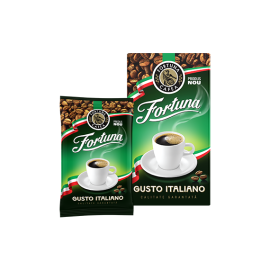
A complex blend that takes you to Italian lands — the character of an authentic espresso.
R&G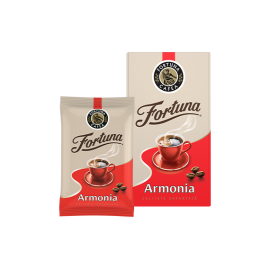
Energy in a subtle, delicate way — sweet chocolate, caramel and dried fruit, with a velvety body.
Beans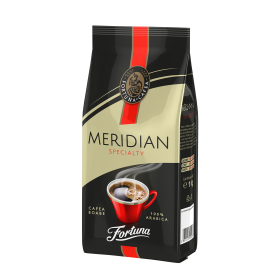
Exotic floral-fruity aromas over dark chocolate tones — sophisticated, slightly acidic, long-lasting.
R&G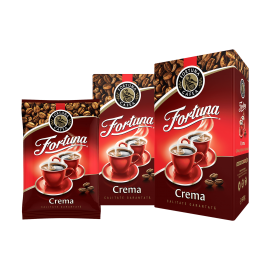
Bitter and intense — raw dark chocolate with spicy overtones, and twice the caffeine.
Beans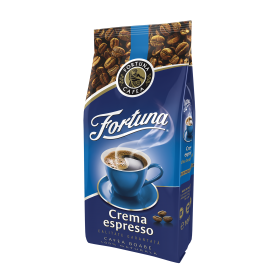
Powerful and delicate at once — the strength of Robusta with the finesse of Arabica.
From the laboratory to the one-way valve on every pack, the whole journey serves a single promise — the same taste, in every cup.
Discover Cafea Fortuna

